Alex Hitchen
Mixed Media Collage
○ Painted Paper Collage - Using painted paper, students will learn about Shape and Balance while creating a composition that tells a story or holds meaning. In a one day session, students would be provided with paper that is already painted, shown examples, and given guidance in planning and then creating their compositions. In a two day (or more) session, students will spend more time in the planning stage, have the opportunity to paint the paper themselves, and experiment with color mixing and creating textures.
■ Pedagogically aligns with Choice-Based Art Education (CBAE) and Teaching for Artistic Behavior (TAB)
■ Ideal for 1 or two sessions (could be as much as a five day unit)
■ Great for Schools - MS, HS - Hospitals, Cancer Patients - Community Groups, Neurodivergent communities such as ASD - Inpatient/OutPatient Facilities, Libraries
■ All written materials are presented to students in English and Spanish, and available to be adapted to any other languages requested.
○ Braille Collage - This lesson teaches students about the history of braille and how it relates to tactile art forms. Students will create collages, using magazines and then on top of these collages, include a word, phrase or sentence in Braille. We work up to this by seeing the Braille alphabet, translating our own names and then brainstorming what words will be present in their college. Using raised materials like puffy paint, dot stickers and googly eyes, students will place their message over their finished collage. If/when time allows, we will try to translate each other's works.
■ Pedagogically aligns with Culturally responsive teaching
■ Ideal for Two -Three Sessions (could be as much as a five day unit)
■ Schools - MS, HS - Hospitals, Cancer Patients - Community Groups, Neurodivergent communities such as ASD - Inpatient/OutPatient Facilities, Libraries
■ This lesson discusses visual impairedness and could be therefore sensitive to some students.
Oil Pastel Crayons
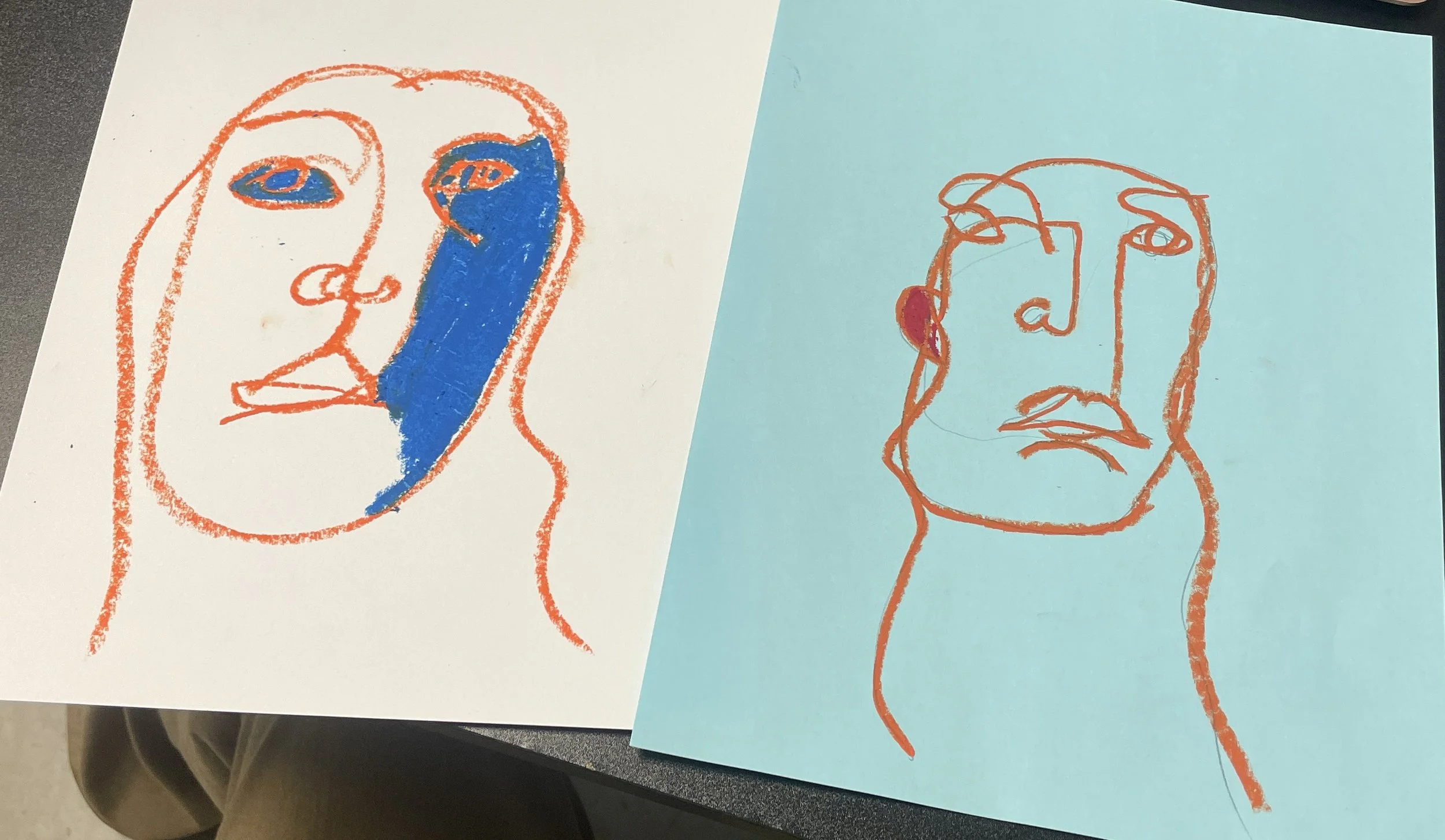
○ Blind Contour Drawing - This simple lesson allows students to train their eyes to draw just what they see and not how they think things should be drawn. This lesson is ideal for quieting the perfectionist brain and introducing art to students without pressure of “doing it right”. Students will have a mirror set up next to them and they will look into the mirror while also drawing themselves without looking at their paper - fixing their gaze on each part of their face that they are drawing. We warm up this activity by drawing each other first with pencil and paper, then we draw ourselves using oil pastels on cardstock.
■ Pedagogically aligns with Culturally responsive teaching
■ Ideal for 1 session (could be as much as a three day unit)
■ Schools - MS, HS - Hospitals, Cancer Patients - Community Groups, Neurodivergent communities such as ASD - Inpatient/OutPatient Facilities, Libraries
○ Color Temperature Still-Life - In this unit we dive into a science lesson wrapped into our art education. Students will learn about how our eyes see color, how color is light and how we can use that information in our artwork. In this lesson, students will have the opportunity to bring in items that are personal to them if they would like, to use as a model in their final still-lifes. When drawing their still lifes, we will use oil pastel crayons to explore color temperature of the subjects they chose.
■ Pedagogically aligned with STEAM and Choice-Based Art Education (CBAE)
■ Ideal for two or more sessions (could be as much as a ten day unit)
■ Schools - MS, HS - Hospitals, Cancer Patients - Community Groups, Neurodivergent communities such as ASD - Inpatient/OutPatient Facilities, Libraries
■ This is a more advanced lesson, for students who are already familiar with the color wheel.
Watercolor
○ Landscape - In this lesson students learn about how to create depth by using background, middle ground and foreground. We explore three different watercolor techniques including wet-on-wet, wet-on-dry and resist using salt. In discussing a new medium I always like to discuss the science behind that medium and so with watercolor we learn about pigments and how resist forms like salt or wax work.
■ Pedagogically aligns with STEAM
■ Ideal for two or three sessions (could be as much as a ten day unit)
■ Schools - MS, HS - Hospitals, Cancer Patients - Community Groups, Neurodivergent communities such as ASD - Inpatient/OutPatient Facilities, Libraries
Drawing
○ Using Shape to Draw - Students will learn to break down reference images into shapes, to aid them in drawing things they see. This is a student favorite and often leads to a jump in artistic growth for many, in my experience. I start by showing examples and how the artists started with shapes and built their sketches from there. I then demonstrate this in action by drawing an item, using shapes only first before beginning to add details that make the shapes into recognizable images. Students will then get the chance to do this themselves, by first using an expo pen to draw over their reference photos (photos are in a clear sheet protector) before copying those shapes onto their own paper and then drawing the reference photo on that paper with those shapes as guide. When students complete their rough sketch, they will use color pencil to color in their drawing to whatever detail level or style they would like.
■ Pedagogically aligns with TAB
■ Ideal for 1 or two sessions (could be as much as a five day unit)
■ Schools - MS, HS - Hospitals, Cancer Patients - Community Groups, Neurodivergent communities such as ASD - Inpatient/OutPatient Facilities, Libraries
○ Tools for Transfer - Students get the chance to learn several ways in which an artist might take their sketch or a reference photo to then create their works onto the substrate of their choice. While some artists can sketch their work onto a canvas without reference photos or a practice sketch, most artists require references to provide the outline of what they want to create. In this lesson I will show students how to trace with a projector, how to use transfer paper, tracing paper and how to use a grid to transfer an image. Students will then use the method of their choice to create a line drawing with black markers.
■ Pedagogically aligns with TAB
■ Ideal for two or three sessions (could be as much as a ten day unit)
■ Schools - MS, HS - Hospitals, Cancer Patients - Community Groups, Neurodivergent communities such as ASD - Inpatient/OutPatient Facilities, Libraries
Acrylic Paint
○ Pop Culture Characters using a Grid - Students are shown in this lesson how to use a grid system to take a reference image and recreate it on another surface. Students start with a few simple exercises before using a grid to transfer an image of a cartoon character onto a canvas. Then, we will use acrylic paint to paint in our characters, painting over the grid. This technique is used by many artists to get their sketches onto the substrate they are working with, and are of benefit for students of any degree of artistic ability.
■ Pedagogically aligns with TAB and Culturally responsive training
■ Ideal for three sessions (could be as much as a seven day unit)
■ Schools - MS, HS - Hospitals, Cancer Patients - Community Groups, Neurodivergent communities such as ASD - Inpatient/OutPatient Facilities, Libraries
About Alex